How Minesweeper Numbers Are Calculated
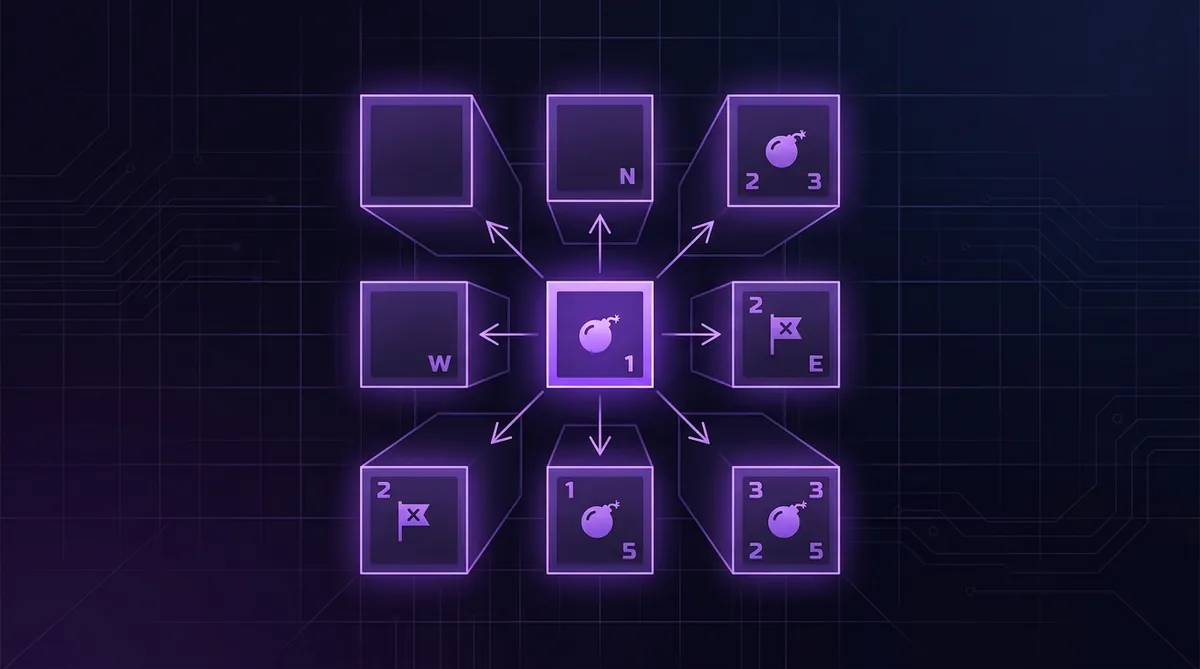
A Minesweeper number counts the mines in the eight cells touching it, diagonals included. That is the whole rule. Because an edge cell has only five neighbors and a corner cell only three, the same digit carries very different information depending on where it sits: a 3 in the corner means every neighbor is a mine, while a 3 in the open means three out of eight.
Every number in Minesweeper tells you something important. It's like a little clue sitting right there on the board. But what exactly does that number mean? And how does the game figure it out?
Let's break it down so it makes total sense.
What "Adjacency" Actually Means
When you click a square and see a number, that number counts how many mines are touching that square. That's it. But "touching" doesn't just mean left, right, up, and down. It also means diagonally.
So every square on the board can touch up to 8 other squares. Think of it like a tic-tac-toe grid. Your square sits in the middle, and the 8 squares around it are its neighbors.
Position changes everything. A "3" in the corner means ALL three of its neighbors are mines. But a "3" in the center? That means only 3 out of 8 neighbors are mines. Same number, very different situation.
How the Game Calculates Each Number
When the game builds a new board, it follows a simple process. First, it places all the mines in random spots. Then it goes through every single non-mine square and counts how many mines sit in the 8 surrounding squares. That count becomes the number you see.
If zero mines are nearby, the square stays blank. You've probably seen this happen. You click one square and a whole chunk of the board opens up. That's because blank squares have no adjacent mines, so the game automatically reveals their neighbors too.
Why This Matters for Your Game
Understanding adjacency is the foundation of everything in Minesweeper. Once you know that each number counts all 8 neighbors, you can start using logic to find safe squares.
Look at it this way. If a "1" already touches one flagged mine, then all its other neighbors must be safe. You can click them without worry. This is the core idea behind the 1-1 rule, and it's one of the first tricks every player should learn.
And when two numbers sit next to each other, their neighbor zones overlap. That overlap is where the real logic happens. You can compare what each number "sees" and narrow down where mines must be. This is how the 1-2 rule works for solving tricky corners.
Common Mistakes Beginners Make
The biggest mistake? Forgetting about diagonal neighbors. New players often think a "2" only counts squares directly above, below, left, or right. But diagonals count too. Always check all 8 directions.
Another common error is ignoring position. A "1" on the edge of the board has fewer neighbors than a "1" in the middle. So that edge "1" actually gives you stronger information. Fewer possible spots means easier deductions.
Putting It All Together
So here's the full picture. Every number on the board is a count of mines in the 8 surrounding squares. Corner squares only have 3 neighbors. Edge squares have 5. Everything else has 8. The game calculates these numbers automatically after placing mines.
Once you truly understand this, patterns start jumping out at you. You'll notice formations like 1-2-1 and recognize what they mean right away. Check out our pattern bible to learn the most common ones.
But nothing beats practice. The best way to train your brain is to play minesweeper and actively think about what each number is telling you. Don't just click randomly. Pause. Count the neighbors. Use the numbers.
Ready to test yourself? Try the today's challenge and see how fast you can solve today's board using what you've learned. And if you want to track your progress over time, sign up free to save your stats and climb the ranks.
Try what you just read: Beginner Minesweeper · Intermediate Minesweeper · Expert Minesweeper · No-Guessing mode · Défi Quotidien. For technique deep-dives, see the patterns guide, efficiency & 3BV/s guide et Minesweeper FAQ.
Run the numbers with the Minesweeper 3BV calculator, see how good your time is, or read more in the Minesweeper guides.