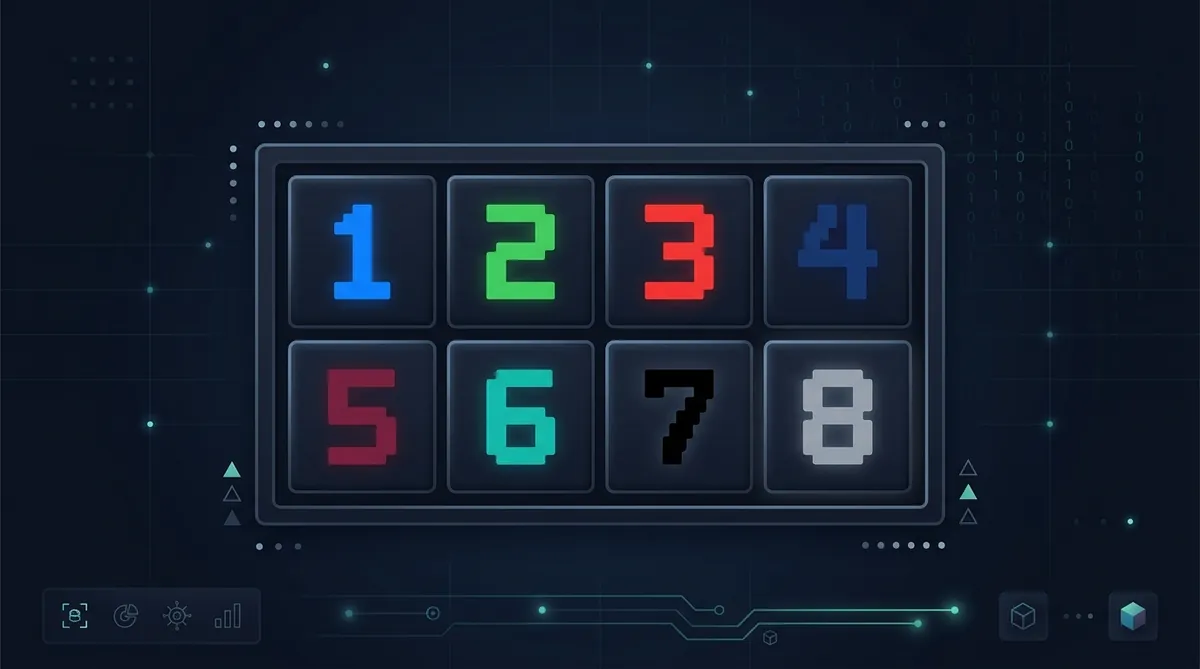
Minesweeper Number Meanings: A Detailed Chart from 1 to 8
Every number in Minesweeper counts the mines in the eight squares touching it, diagonals included. A 1 means one adjacent mine, a 2 means two, up to 8. The classic colors are fixed - 1 blue, 2 green, 3 red, 4 dark blue, 5 maroon - so you can read the board by color before you read the digit.
If you've ever stared at a Minesweeper board wondering what those numbers actually mean, you're in the right place. This is your go-to guide for every number from 1 to 8. We'll cover what each number tells you, what color it shows up as, and how often you'll actually see it. Let's dig in.
What Do the Numbers Mean?
Every number in Minesweeper tells you exactly how many mines are touching that square. That includes all 8 squares around it, the ones above, below, left, right, and diagonal. So a "3" means three of those neighboring squares have mines. Simple as that.
And once you really get that idea, the whole game starts to make a lot more sense. You're not guessing randomly anymore. You're reading clues.
Want to go deeper on how the counting actually works? Check out this adjacency guide that breaks it all down.
The Big Reference Chart: Numbers 1 Through 8
Tips for Reading Each Number
Low numbers like 1 and 2 are your best friends. They narrow down where mines can be. A 1 in a corner only has three neighbors, so figuring out which one has the mine gets a lot easier. This is where the famous safe clicks comes in handy.
Mid-range numbers like 3 and 4 need more attention. You can still solve them with logic, but you'll want to look at surrounding clues too. Don't just stare at one number. Look at the whole picture.
High numbers like 5, 6, and 7 are stress-inducing, but they're actually useful. They tell you a lot of the nearby squares ARE mines, which means you can flag them fast and move on. So in a weird way, seeing a 5 or 6 is almost helpful.
What About the Number 8?
The 8 is basically a Minesweeper legend. It means every single square touching it is a mine. All 8 of them. So when you uncover an 8, you don't need to think at all. Just flag everything around it and move on. But don't hold your breath waiting to see one. They're incredibly rare. Curious how rare? Read more about the rare 8 and what makes it so unusual.
And if you want to know the actual odds of seeing a 7 or 8 in a real game, there's a great breakdown in the rare numbers article. Spoiler: it's not very likely.
Practice Makes It Click
Reading numbers gets way easier once you actually play a few rounds. It stops feeling like math and starts feeling like reading a map. You'll start recognizing patterns without even thinking about it.
So go online minesweeper and test out what you just learned. Even a few games on easy mode will help it all click. And if you want a more structured walkthrough, the beginner guide has you covered.
Look, every expert player started by staring at these same numbers and feeling confused. Now you've got the chart. You're already ahead.
Try what you just read: Beginner Minesweeper · Intermediate Minesweeper · Expert Minesweeper · No-Guessing mode · Daily Challenge. For technique deep-dives, see the patterns guide, efficiency & 3BV/s guide and Minesweeper FAQ.
Run the numbers with the Minesweeper 3BV calculator, see how good your time is, or read more in the Minesweeper guides.