The Minesweeper Pattern Bible: How to Recognize 1-2-1, 1-2-2-1, and 2-1-2 Formations
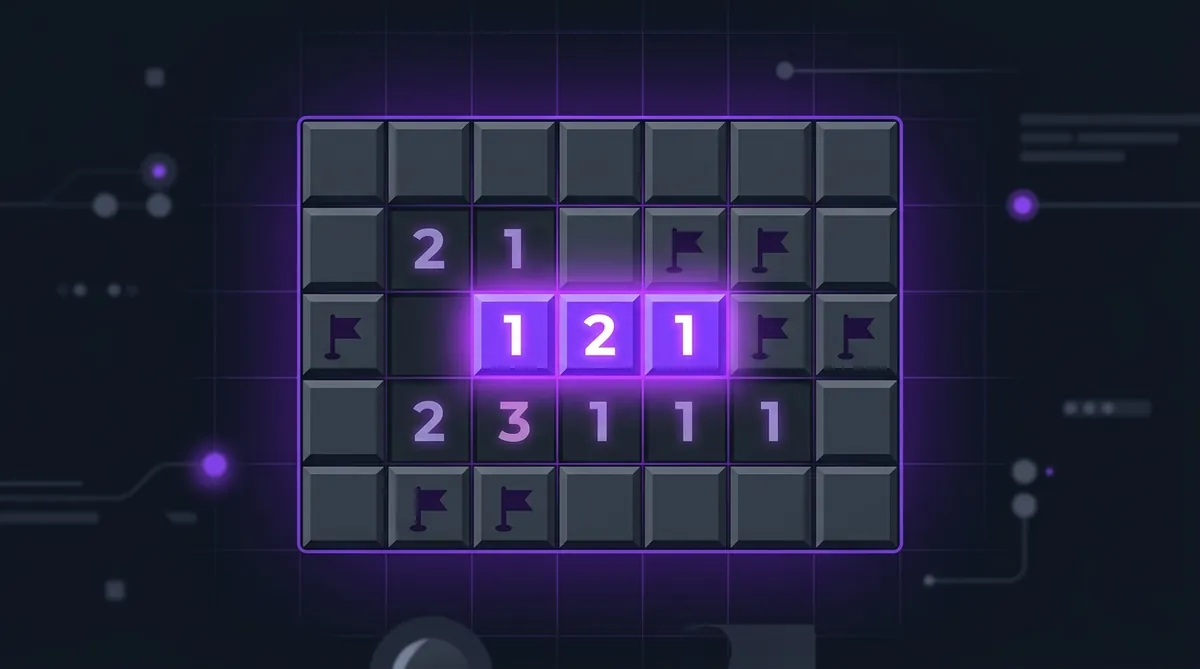
In a 1-2-1 the mines sit across from the two 1s and the cell across from the 2 is safe. In a 1-2-2-1 it inverts: the mines are across from the two 2s and the cells across from the end 1s are safe. A 2-1-2 needs a covered row one cell wider than the numbers, and puts a mine across from the middle 1 with the cells across from the 2s safe. Those three formations resolve most of the spots where players think they have to guess.
You're staring at a row of numbers. You know there's a mine hiding somewhere. But where? If you've ever felt stuck in Minesweeper, you're not alone. The good news is that most tricky spots follow a handful of common patterns. Once you learn to spot them, you'll clear boards faster than ever, and you'll guess far less often.
Let's break down the most important number formations in Minesweeper. These are the bread and butter of every skilled player: the 1-2-1, the 1-2-2-1, and the 2-1-2. Learn them, and you'll stop guessing and start knowing.
What Are Number Patterns?
In Minesweeper, every number tells you how many mines are touching that square. But one number by itself rarely tells the whole story. When you read numbers together, they start pointing to exactly where mines are hiding. That's what pattern recognition is all about.
Think of it like reading a sentence instead of single letters. The numbers work together to paint a picture. Once you learn the common "sentences," you'll read the board like a book. Two foundational ideas power every pattern in this guide: the 1-1 rule for safe clicks and the way adjacency counts neighbors. If those two ideas click, the rest follows naturally. For even more formations to study, see our patterns reference.
One quick note on notation. Throughout this guide we'll write a known number row above a row of unknown covered cells. In the grids below, a digit is a revealed number, ? is a covered (unknown) cell, M marks a confirmed mine, and a period marks a confirmed safe cell.
The 1-2-1 Pattern
This is the first pattern every player should learn. It's simple, and it shows up constantly, especially along the top or bottom wall of the board.
Picture three numbers in a row along an edge, with covered cells directly across from them:
1 2 1
? ? ?
Where are the mines? The answer: the mines sit directly across from the two 1s. The square across from the centre 2 is safe. Every time. You can click it with confidence.
1 2 1
M . M
Tip: The 1-2-1 works along walls, edges, and even in the middle of the board whenever you have a straight line of cleared cells on one side. Train your eyes to scan for it everywhere, not just on borders.
Why does it work? Walk through the logic. The left 1 touches the first two covered cells, the right 1 touches the last two, and the centre 2 touches all three. Now test the middle cell. If it held a mine, that single mine would satisfy both 1s at once, forcing the two outer cells to be safe - and then the 2 would see only one mine when it needs two. That is impossible, so the middle cell must be safe. With the middle ruled out, each 1 has only one cell left to hold the mine it needs, which puts mines under both 1s, and those two mines are exactly what the centre 2 was asking for. Everything checks. It's deduction, not luck.
The 1-2-2-1 Pattern
This one is the 1-2-1's bigger sibling. You've got four numbers in a row, and it's just as reliable:
1 2 2 1
? ? ? ?
The mines sit across from the two 2s. The squares across from the 1s on each end are safe. Go ahead and click them.
1 2 2 1
. M M .| Number | Square Across |
|---|---|
| 1 (left end) | Safe |
| 2 | Mine |
| 2 | Mine |
| 1 (right end) | Safe |
This pattern is satisfying to spot because it resolves two safe squares and two mines at once. And it appears more often than you'd think, especially on bigger boards where long borders form. If you want a fresh layout to hunt for it on, try the daily Minesweeper challenge for a new board every day.
The 2-1-2 Pattern
Now here's one that trips people up, and the first thing to get right is how wide it is. A 2-1-2 needs the covered row to run one cell further out on each side than the numbers do. Over just three covered cells the position cannot exist at all: the two 2s would together demand four mines from cells the middle 1 caps at one.
  2 1 2
? ? ? ? ?
The mine sits directly across from the 1 in the middle, along with the far cell at each end. The two cells across from the 2s are safe:
  2 1 2
M . M . M
It feels wrong at first, because you'd expect the low number to be the dangerous one. Test the alternative and it collapses. Suppose the cell under the 1 were safe. The left 2 could then only reach two candidate cells and would need mines in both; the right 2 would need mines in both of its own two. That puts a mine on each side of the 1 - two mines against a clue that allows exactly one. So the cell under the 1 has to be the mine. That single mine satisfies the 1 completely, which forces the cells under both 2s to be safe, and each 2 then takes its second mine from the outer cell on its own side.
Key Takeaway: Do not read these shapes one number at a time, and do not assume a low number means safety nearby. Each formation is a small system of simultaneous constraints, and in two of the three the answer is the opposite of what intuition suggests. Test the cell you are unsure about by assuming it is safe: if that assumption forces a contradiction somewhere else in the row, it is a mine.
How to Spot Patterns Faster in Real Games
Knowing the patterns is half the battle; spotting them under time pressure is the other half. Here's how to train the skill:
Slow down at the edges. Most of these formations appear along borders where you have a clean row of revealed numbers. Before you guess, scan for 1-2-1, 1-2-2-1, or 2-1-2 sequences running along any wall.
Reduce numbers as you flag. A powerful habit is mentally subtracting flagged mines from nearby numbers. A 2 sitting next to one confirmed mine effectively becomes a 1, and suddenly a 1-2-1 may appear where you didn't see one before. The 1-2 logic rule for tight corners leans heavily on this trick.
Practice on purpose. When you play Minesweeper online, don't just rush. Take a moment to look for formations before clicking. Speed comes after understanding, not before it. Start on beginner boards to build pattern memory, then move up to intermediate and finally expert mode where these patterns pay off the most.
Common Mistakes to Avoid
- Forcing a pattern that isn't there. A 1-2-1 only works when all three numbers share the same row of covered cells. If a cleared cell or board edge breaks the line, the rule may not hold. Always confirm the geometry first.
- Ignoring mines on the back side. These patterns assume the covered cells are only on one side of the numbers. If there are unknowns above and below, you need to account for both before trusting the result.
- Flagging instead of clearing. Patterns reveal safe squares too. Many players flag the mine and stop, missing the free safe clicks the pattern hands them. Take the safe cells; they speed you up.
Pattern FAQ
Does the 1-2-1 work in the middle of the board?
Yes. It works anywhere you have three numbers in a line with covered cells along one side. Walls are just the most common place to see a clean version of it.
What if I see a 1-2-1 but the surrounding cells aren't fully cleared?
Then the pattern may be contaminated by mines you haven't accounted for. Only apply the rule when each number's neighbors are fully known except for the single row of unknowns the pattern depends on.
Are these patterns enough to win without guessing?
They cover a huge share of real-game decisions, but Minesweeper occasionally produces genuine 50/50s where no pattern helps. For those moments, see our guide on the 50/50 problem, and consider no-guessing mode, which removes forced coin flips entirely.
So next time you're stuck on a board, don't panic. Scan the numbers. Look for these shapes. Let logic do the work for you. With practice, pattern recognition becomes automatic, and you'll be climbing the player rankings in no time. For a deeper reference on individual formations, bookmark our Minesweeper patterns FAQ.
Try what you just read: Beginner Minesweeper · Intermediate Minesweeper · Expert Minesweeper · No-Guessing mode · Défi Quotidien. For technique deep-dives, see the patterns guide, efficiency & 3BV/s guide et Minesweeper FAQ.
Run the numbers with the Minesweeper 3BV calculator, see how good your time is, or read more in the Minesweeper guides.