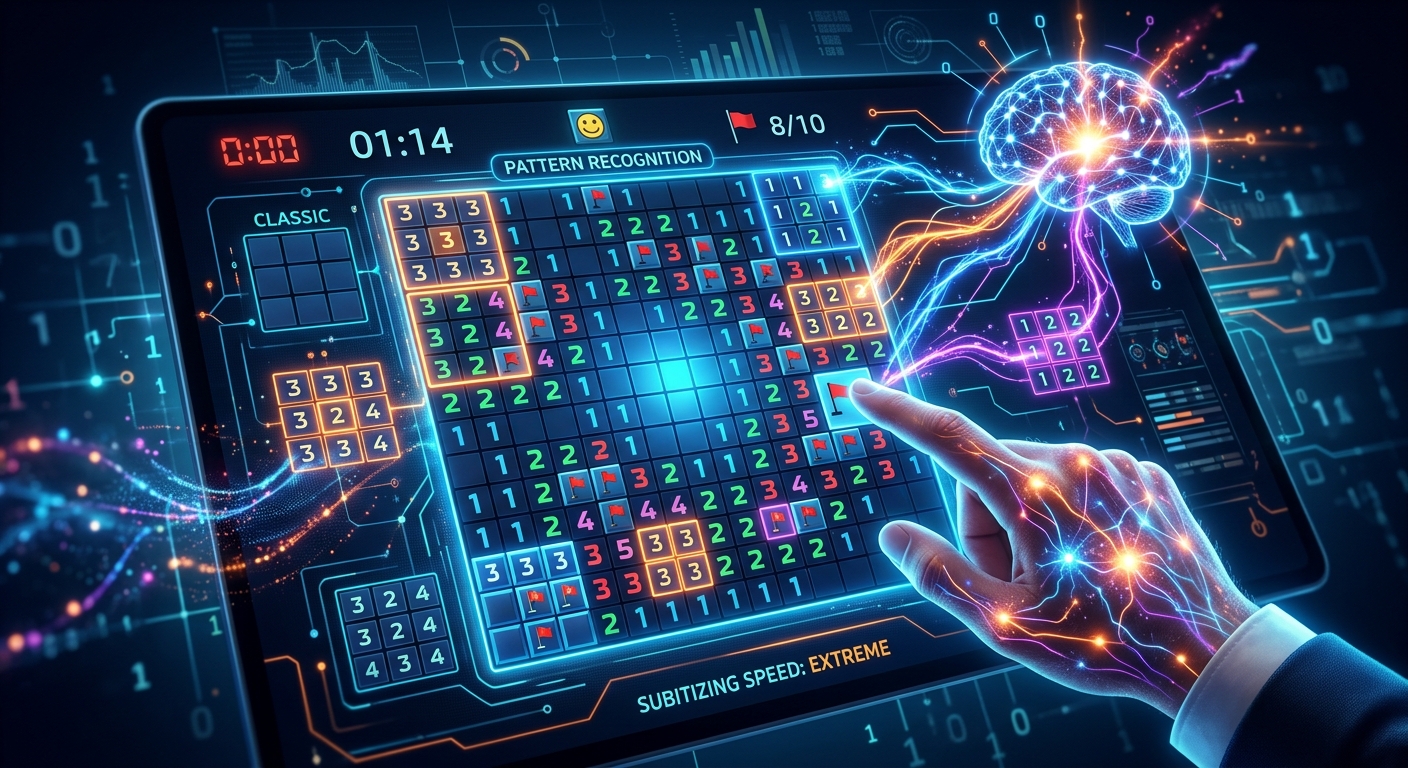
How Subitizing Shapes Minesweeper Pattern Recognition and Speed
There is a moment every improving Minesweeper player eventually experiences. You glance at a number cluster and your cursor is already moving. You did not count. You did not work through each adjacent cell one by one. The answer arrived whole, as if the board handed it to you without effort. That moment has a name in cognitive science: subitizing. Once you understand what it is and how it operates inside a Minesweeper session, your own progress will start to make sense in a way it never did before.
Pattern Insight
- Subitizing is the brain's built-in ability to recognize small quantities instantly, without counting each item separately.
- Expert Minesweeper players perceive common number clusters like 1-2-1 and 1-1 as single visual units, not collections of separate numbers.
- Beginners count cells one at a time; experienced players absorb entire patterns in a single eye fixation.
- Deliberate board practice compresses the time it takes to process board states by expanding and sharpening the subitizing window.
- Measuring your baseline perceptual speed before training gives you a concrete reference point for tracking real improvement.
The Brain Mechanism That Skips Counting Entirely
Subitizing is not a skill you learn from a book. It is a built-in feature of human perception. The word comes from the Latin subitus, meaning sudden. When you see two dots on a dice face, you do not count them. You perceive the quantity two immediately, as a single impression. Studies in numerical perception show that most adults subitize accurately up to about four items, sometimes five. Beyond that threshold, the brain switches to deliberate counting or rough estimation.
What makes subitizing genuinely powerful for Minesweeper is that it does not apply only to raw quantities. With enough exposure, the brain learns to subitize patterns. A familiar spatial arrangement gets recognized as a whole, not assembled piece by piece from its parts. This is why experienced chess players recognize board positions rather than computing them fresh every turn. It is also why a seasoned Minesweeper player can scan a row of numbers and extract meaning in fractions of a second.
The limitation is that subitizing only works for things your brain has been trained to treat as single units. You cannot instantly perceive a pattern you have never truly internalized. That is exactly where deliberate Minesweeper practice enters the picture.
What a Beginner Sees vs. What an Experienced Player Sees
Put a beginner in front of an intermediate Minesweeper board and watch their eyes. They will typically fix on one number, check the adjacent unrevealed cells, count any flagged mines nearby, subtract, then move to the next number and repeat the entire cycle. The process is sequential and deliberate. It works. But it is slow, and it burns cognitive energy at a rate that becomes exhausting across a long game.
An experienced player scanning the same board behaves differently. Their eyes make fewer, longer fixations. They jump between clusters rather than individual numbers. A row that reads 1-2-1 does not register as three separate data points. It registers as a single known configuration with a single known implication. The player does not derive this conclusion. They retrieve it, the same way you retrieve the meaning of a familiar word rather than sounding out each letter.
This shift from derivation to retrieval is the core of what subitizing and pattern recognition together produce. The board stops being a logic puzzle that must be solved fresh each time and starts being a visual language the player already speaks fluently.
Board Patterns That Collapse Into Single Perceptual Units
Reading the 1-2-1 Configuration at a Glance
The 1-2-1 pattern appears frequently on standard Minesweeper boards and is one of the first configurations that players deeply internalize. In the classic version, three numbered cells sit in a row. The first and last each border exactly one unrevealed square. The middle cell borders two. Once you know the rule, the implication is immediate: the mines sit outside the 2, adjacent to each 1, and the cells flanking the 2 on the inside are safe to clear.
A beginner works through this with three separate analysis steps, checking each number in turn. An intermediate player who has faced this pattern hundreds of times processes the entire thing in one fixation. The three numbers have collapsed into a single visual token with a known meaning attached. That compression is subitizing operating on spatial pattern rather than on raw quantity.
The 1-1 Configuration and What It Signals Immediately
The 1-1 pattern is even more fundamental. Two adjacent cells each show a 1, both sharing a line of unrevealed cells. When the geometry lines up correctly, the experienced player can immediately flag or clear a mine without consciously stepping through the logic. The reasoning is elegant. More importantly for speed, it becomes automatic with repetition.
The first time you encounter this setup, you may spend thirty seconds reasoning through it. The hundredth time, your hand moves before the thought fully forms. That is not intuition in any vague sense. That is perceptual learning, and subitizing is the underlying mechanism making it possible.
Benchmarking Your Perceptual Speed Before You Train
Before you can measure improvement, you need a starting point. A subitizing test gives you exactly that. These tests flash brief groupings of dots or objects and ask you to report the quantity you saw. The display duration is short enough that counting is impossible. You are forced to rely purely on immediate perception.
Your score reveals your current subitizing ceiling. Most untrained adults accurately subitize up to four items. Consistent accuracy at five or above indicates a stronger perceptual baseline. Consistent errors below four suggests room for improvement even before any Minesweeper-specific practice begins. Pay attention to these things during the test:
- The quantity at which you first start hesitating before answering
- Whether your errors cluster around a particular number or feel scattered
- How your response time changes as the quantities increase
- Whether familiar spatial groupings, like dice-face arrangements, feel faster than irregular dot clusters
This baseline matters because subitizing is genuinely trainable. Perceptual learning research consistently shows that exposure to patterns combined with immediate feedback shifts the recognition threshold upward over time. Minesweeper provides both conditions in abundance: repetitive pattern exposure and instant feedback with every cell you click or flag.
How Deliberate Practice Trains the Subitizing Window Over Time
The progression from deliberate counting to effortless pattern recognition does not happen by accident. It follows a predictable sequence that applies to most players who put in consistent time. Here is how that sequence tends to unfold:
- Cell-by-cell analysis. The player examines each numbered cell in isolation, counting adjacent unrevealed squares and comparing against the number shown. Every decision requires a full reasoning cycle from scratch.
- Local pattern spotting. The player begins recognizing two or three cell configurations they have encountered before. Solving those clusters becomes faster, while the rest of the board still demands deliberate analysis.
- Chunked scanning. Several common patterns now process as units. The player's eyes start moving in larger jumps across the board. They are reading sections rather than individual numbers.
- Peripheral processing. Familiar patterns start registering at the edges of focus. The player does not need to look directly at a 1-2-1 to recognize it when it falls within a few degrees of their focal point.
- Anticipatory movement. The cursor begins moving toward a cell before the conscious decision is fully formed. The perceptual and motor systems are working in closer parallel, and reaction time compresses noticeably across a timed run.
Each stage requires genuine repetition. There is no path around the middle steps. But the transitions are not vague milestones. You will feel when you cross each one, because the experience of playing changes in a tangible way. The board feels less cluttered. Your eyes feel less strained. Decisions that used to cost real effort start arriving without friction.
When the Board Starts Talking Back
The clearest sign that subitizing has reshaped your Minesweeper perception is the moment the board feels interactive rather than interrogative. You are no longer pulling answers out of it. It is offering you information unprompted. Your eyes land on a cluster and the implication forms before you consciously register exactly what you saw.
That shift has real consequences in competitive play. Speedrun times on beginner and intermediate boards are heavily influenced by scan efficiency. Milliseconds saved on each pattern recognition event compound across hundreds of decisions in a single run. Players who have pushed their subitizing ceiling higher and built a wider pattern vocabulary are not just faster at processing individual cells. They are spending less cognitive energy per decision, which means they stay sharp deeper into longer boards and under the pressure of a ticking clock.
Tracking that improvement starts with knowing where you began. The baseline you measure before deliberate practice is the reference point that makes your growth visible and motivating. And the patterns you build into your visual memory, one board at a time, are the vocabulary that eventually lets you read Minesweeper the way a fluent reader reads text: not symbol by symbol, but in whole units of meaning that arrive fully formed.
Try what you just read: Beginner Minesweeper · Intermediate Minesweeper · Expert Minesweeper · No-Guessing mode · Desafio Diário. For technique deep-dives, see the patterns guide, efficiency & 3BV/s guide e Minesweeper FAQ.
Run the numbers with the Minesweeper 3BV calculator, see how good your time is, or read more in the Minesweeper guides.