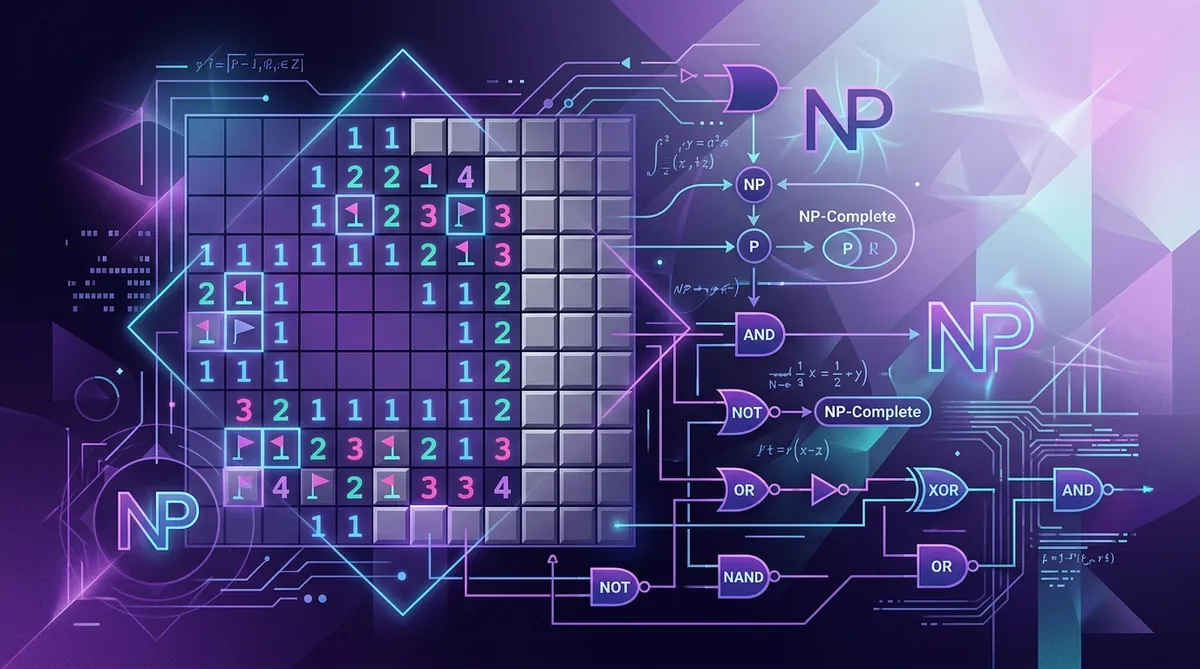
Is Minesweeper NP-Complete? The Mathematics and Logic Behind the Game
Yes, though the precise result is narrower than the popular phrasing. What was proven NP-complete is the Minesweeper Consistency Problem: given a partially revealed grid of numbers, is there any placement of mines consistent with all of them? Deciding which specific squares are safe is at least as hard as that.
You're sitting there, staring at the board, totally stuck. You've used every clue. You've counted every number. And yet you still have to guess. Sound familiar? That moment isn't always bad luck. Sometimes it's math. Deep, serious, computer-science math.
The Minesweeper consistency problem was proven to be NP-complete. That's an intimidating term, but it's actually simple to understand once you break it down, and it explains a lot about why the game can feel impossible at exactly the wrong moments.
What Does NP-Complete Even Mean?
Think of it this way. Some problems are easy to check but hard to solve, like a jigsaw puzzle. Once it's finished, a glance tells you it's correct. But actually assembling it from scratch takes real work.
NP-complete problems are exactly like that. Verifying a proposed answer is fast. Finding the answer in the first place can be brutally hard. And "complete" adds one more thing: these are the hardest problems in the class NP, in the sense that any other NP problem can be rewritten as one of them. Solve one efficiently and you've solved them all.
So when we say a Minesweeper problem is NP-complete, we mean this: if someone hands you a board and a claimed assignment of mines, checking that it's consistent with the numbers is quick. But determining whether a consistent arrangement exists at all, in general, has no known fast, reliable method, not for you and not for a supercomputer.
Key Takeaway: NP-complete means easy to verify, hard to solve in general. The Minesweeper consistency problem fits that description, and a formal proof backs it up.
What Exactly Was Proven?
It's worth being precise, because the popular phrasing oversimplifies it. The result is about the Minesweeper Consistency Problem: given a partially revealed grid of numbers, is there any placement of mines consistent with all of them? That yes/no question is the NP-complete one. The related task of deciding which specific squares are safe is at least as hard. So both the "is this board even legal" question and the "what's safe here" question sit firmly in hard territory.
Who Proved It, and How?
A mathematician named Richard Kaye published a paper in 2000 that made the gaming world do a double-take. He showed that the Minesweeper consistency problem is just as hard as the classic Boolean satisfiability problem, the original NP-complete problem.
His method was elegant. He built Minesweeper configurations that behave like logic gates, the AND, OR, and NOT switches at the heart of every computer. Using nothing but mines and numbers on a grid, he constructed wires that carry a true/false signal, gates that combine those signals, and splitters that duplicate them. String enough of these together and you can encode any logic circuit, and therefore any SAT formula, as a Minesweeper board.
The consequence is striking: a Minesweeper grid can, in principle, simulate the components of a computer. A very stressful, mine-filled computer, but a computer nonetheless.
The core question Kaye reduced to Minesweeper was simple to state: can this board be satisfied at all? His construction shows that if you had a fast method to always answer that, you'd also have a fast method to solve SAT, which would resolve the famous P vs NP question. Nobody has found one, which is exactly why the game can be genuinely hard.
What This Means for You as a Player
Here's where the theory touches the keyboard. Sometimes, no matter how cleverly you play, you'll reach a spot where guessing is unavoidable, not because you missed a clue, but because deciding the position is computationally hard, or because the remaining information truly doesn't determine a unique answer.
| Situation | What's Happening |
|---|---|
| You've used every number clue | Local logical deduction is exhausted |
| Two squares look identical | No way to tell them apart from the visible numbers |
| Corner or edge with no neighbors | Classic forced-guess scenario |
| A large tangled border region | Deduction may require global, expensive reasoning |
So the next time you blow up and feel dumb, don't. You weren't outsmarted. You may have hit a genuine computational wall, the kind even a PhD in complexity theory would have to guess past. The smart play in those spots isn't pure luck either: count the remaining mines, compare the probability of each candidate, and click the safer one. Our 50/50 guide walks through how to pick the better odds, and the 1-2 logic rule can rescue many corners that look forced but aren't.
Want to understand why those numbers behave the way they do in the first place? Our deep dive on how Minesweeper numbers are calculated breaks it down in a satisfying way, and it's the foundation every deduction stands on.
Is Every Board Actually Hard?
No, and this is the reassuring part. NP-completeness is a statement about the worst case, the hardest boards in the whole family. The boards you play day to day are usually solvable with quick local patterns like the 1-1 rule and the classic 1-2-1 formations covered in our patterns guide. Hard instances exist, but they're the exception, not the rule. Most of the time, good pattern recognition carries you all the way home.
How No-Guessing Mode Changes Everything
Here's the good news. Some Minesweeper versions are built to sidestep the worst-case problem. Our no-guessing mode generates boards that are always solvable with pure logic. No forced guesses, ever.
The generator checks each candidate board with a logical solver before you start. If it finds a position that would require a guess, it rebuilds. So you always get a board where deduction alone reaches the end. It's a fascinating twist: the general problem is NP-complete, yet careful board generation can guarantee you only ever face the easy, solvable instances. You can read exactly how that generation works in our board algorithm guide.
Tip: If you're learning Minesweeper or sharpening your logic, start in no-guessing mode. It rewards clean thinking and never punishes you for bad luck. There's a separate no-guessing leaderboard to chase, too.
NP-Complete FAQ
Does NP-complete mean Minesweeper is impossible to solve?
No. It means there's no known method that's both fast and guaranteed correct on every possible board. Plenty of boards are easy, and solvers handle most real games quickly. It's only the worst cases that resist efficient solving.
If I'm forced to guess, did I play wrong?
Not necessarily. On a random board, some positions truly have no logical answer. The best you can do is choose the square with the higher chance of being safe, which is a skill in itself.
How do I avoid forced guesses entirely?
Play no-guessing mode, or read our no-guessing FAQ. Those boards are filtered so logic always wins.
Why This Makes Minesweeper So Interesting
Most people think Minesweeper is just a casual time-killer. But it's secretly one of the most mathematically rich games ever shipped on a desktop. It links directly to some of the deepest open questions in computer science, and it still fits on your phone screen.
Beyond the math, the game teaches something real: logic has limits. Sometimes you work every clue, reason it out perfectly, and still face a coin flip. That's not failure; it's the boundary of what's knowable from the information you have.
Ready to put your logic to the test? Try the daily challenge and see how far pure deduction takes you, or check the leaderboard to see how the best deductive players stack up. The math is hard. The fun? That part's easy.
Part of our complete guide: How to Code Minesweeper: A Complete Guide to Building the Game from Scratch.
Try what you just read: Beginner Minesweeper · Intermediate Minesweeper · Expert Minesweeper · No-Guessing mode · Défi Quotidien. For technique deep-dives, see the patterns guide, efficiency & 3BV/s guide et Minesweeper FAQ.
Run the numbers with the Minesweeper 3BV calculator, see how good your time is, or read more in the Minesweeper guides.