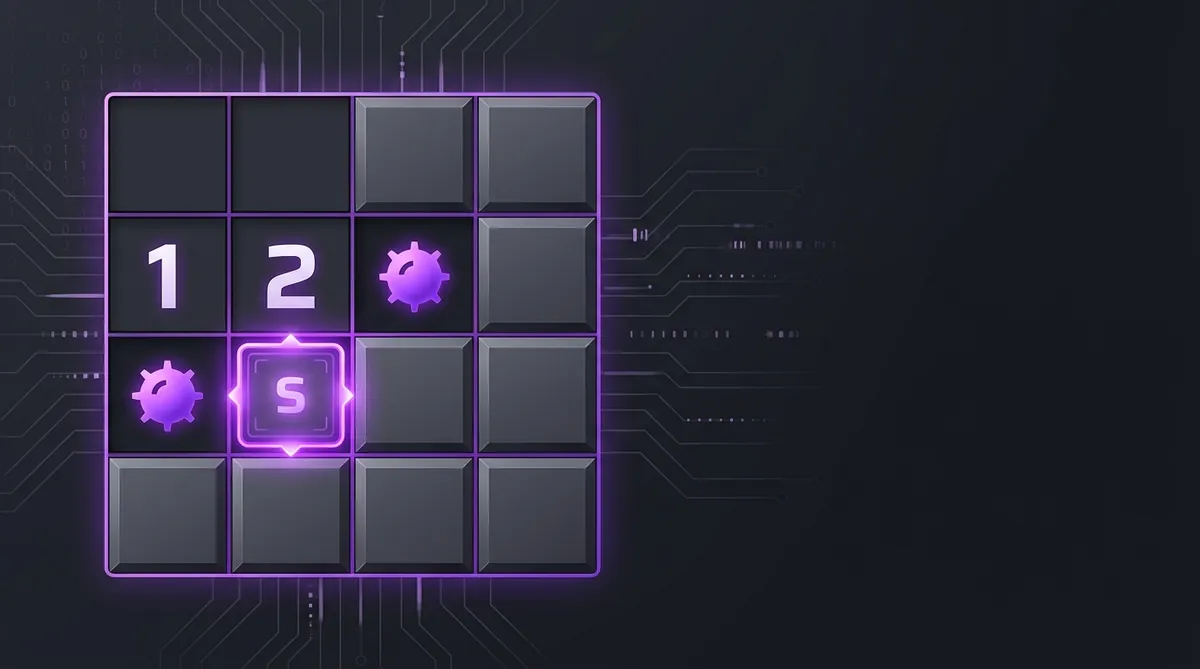
The 1-2 Logic Rule: Solving Tight Corners Without Guessing
The 1-2 rule applies when a 1 and a 2 sit next to each other along a wall. The 1 touches exactly one mine and the 2 touches exactly two, so comparing the hidden squares the pair share tells you precisely where the mines are and which squares are safe. It takes the guess out of tight corners.
You've probably seen it a hundred times. You're playing Minesweeper, you hit a tight corner, and two numbers sit right next to each other: a 1 and a 2. You freeze. You guess. You blow up. Sound familiar?
That 1-2 combo isn't random noise. It's a signal. And once you learn to read it, you'll stop guessing in those spots forever. Let's break it down nice and simple.
What Is the 1-2 Rule?
The 1-2 rule is a logic pattern you can use when a "1" cell and a "2" cell sit next to each other along a wall or border. The key idea is this: the "1" already touches one mine. The "2" touches two mines. By comparing which hidden squares they share, you can figure out exactly where the mines are, and where they aren't.
Think of it like a puzzle. The 1 and the 2 both "see" some of the same hidden squares. But the 2 needs one extra mine that the 1 doesn't care about. That extra mine has to be in a square that only the 2 can see. So that square is a mine. And the squares that only the 1 can see? Those are safe.
How It Looks on the Board
Let's say you have a row of hidden squares along the top edge of the board. Right below them, you see a 1 followed by a 2. The wall blocks everything above, so each number only "sees" the hidden squares directly next to it.
The 1 sees squares A, B, and C. The 2 sees squares B, C, and D. They both share B and C. But only the 1 sees A, and only the 2 sees D.
The 1 needs exactly one mine among A, B, C. The 2 needs exactly two mines among B, C, D. Since the 2 needs one more mine than the 1, and the only square it has "extra" is D, then D must be a mine. And since the 1 only needs one mine total, and it could be in B or C (shared territory), that means A is safe.
Click A with confidence. Flag D. No guessing needed.
Where You'll See This Pattern
The 1-2 pattern pops up all the time in tight spots:
- Board edges and corners. Walls reduce the number of hidden neighbors, which makes the logic cleaner.
- Next to already-flagged mines. Once you flag a mine near a number, that number's "effective" count drops. A 3 next to a flag becomes a 2. A 2 next to a flag becomes a 1. So 1-2 combos appear everywhere once you start flagging.
- Mid-game stalls. When you feel stuck, scan the border between revealed and hidden squares. Look for any 1 sitting next to a 2. It's often your way forward.
Building on What You Know
If you already understand the safe clicks, then 1-2 is the natural next step. The 1-1 rule tells you that two 1s sharing neighbors means the non-shared squares are safe. The 1-2 rule adds one layer: the difference between the two numbers tells you where the extra mine hides.
And it doesn't stop there. This same "subtraction" logic works for 1-3, 2-3, and bigger combos too. Once the idea clicks, you can apply it to all kinds of formations. Check out the common patterns for more advanced setups.
Practice It Right Now
The best way to lock this into your brain is to play. Try no-guessing mode so every game is solvable with pure logic. You'll run into 1-2 patterns constantly, and you'll start spotting them in seconds.
Want more structured practice? The daily challenge is a great way to test your skills against other players. And if you're just getting started, the gameplay guide covers all the basics you need before diving into patterns.
So next time you see a 1 sitting next to a 2 along a wall, don't panic. Do the math. Find the square only the 2 can see. Flag it. Click the safe square. And move on like a pro.
Try what you just read: Beginner Minesweeper · Intermediate Minesweeper · Expert Minesweeper · No-Guessing mode · Daily Challenge. For technique deep-dives, see the patterns guide, efficiency & 3BV/s guide and Minesweeper FAQ.
Run the numbers with the Minesweeper 3BV calculator, see how good your time is, or read more in the Minesweeper guides.